古时候,有一个人希望自己田里的禾苗长得快一点儿,就天天到田边去看。但是,一天天过去了,禾苗一点儿也没长高。他很焦急,自言自语道:“我得想办法让它们长得快一点儿。”
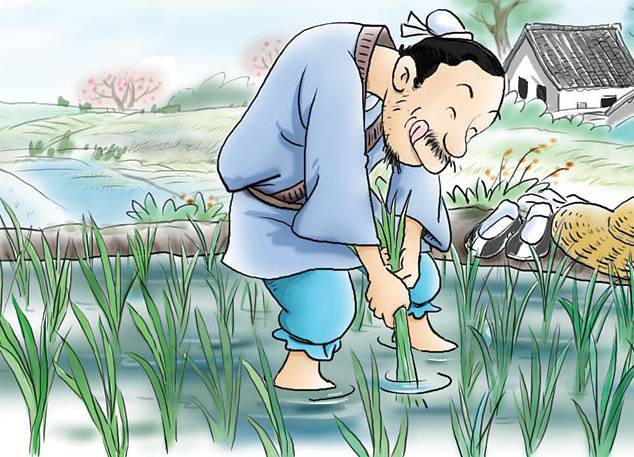
后来,他想到了一个办法,就跑到田里,把禾苗一棵一棵地往上拔,从中午一直忙到太阳下山,拔得精疲力尽。
他回到家,一边喘气一边对儿子说:“可把我累坏了,力气没白费,禾苗都长了一大截。”
他的儿子不明白是怎么回事,跑到田里一看,发现禾苗都枯死了。
这个故事告诉我们:忽视事物发展的规律,用不正当的方法,想要快速达到目的,最后反而会坏了事。
In ancient times, there was a man who wished that the seedlings in his fields grew faster and went to the fields every day to see them. However, day after day the seedlings did not seem to grow up at all.“I have to find a way to help them grow up.”he said to himself anxiously.
Later he thought of a way, and rushed to the fields, pulling up the seedlings one by one. From noon till sunset,he was really exhausted.
When he returned home, he gasped and said to his son, “I’m exhausted and my strength is not in vain. The seedlings have grown a lot.”
His son did not understand what was going on. He ran into the field and saw that all the seedlings were dead.
This story tell us thatit would make things worse, if you ignored the laws of nature and development.
生词
汉字 |
拼音 |
词性 |
英文释义 |
HSK |
禾苗 |
hé miáo |
N. |
seedling |
HSK- |
焦急 |
jiāo jí |
Adv. |
anxiously |
HSK-6 |
自言自语 |
zì yán zì yǔ |
V. |
talk to oneself |
HSK- |
拔 |
bá |
V. |
pull up |
HSK- |
精疲力尽 |
jīng pí lì jìn |
Adj. |
exhausted |
HSK- |
喘气 |
chuǎn qì |
V. |
gasp |
HSK-6 |
白费 |
bái fèi |
V. |
in vain |
HSK- |
忽视 |
hū shì |
V. |
ignore |
HSK-5 |
规律 |
guī lǜ |
N. |
law;rule;discipline |
HSK-5 |
正当 |
zhèng dàng |
Adj. |
proper |
HSK-6 |
语言点:
① 一点儿
(1)用在形容词后,表示程度轻。(Following the adjective, means a lesser degree.)
例如:长得快一点儿;读慢一点儿;写快一点儿
(2)用在“不、没”的前面,表示完全否定(complete negation)。有时,“一点儿”和“不、没”之间可加“也、都”等。“一点儿”+“也/都”+“不/没”
例如:禾苗一点儿也没长高。
你说的一点儿没错。
② 一边......,一边......
连接两个动作(connect two verbs),表示两个动作同时进行(happen at the same time)。
例如:孩子们一边唱歌,一边跳舞。
他一边听音乐,一边做饭。


 苏公网安备 32100302010246号